



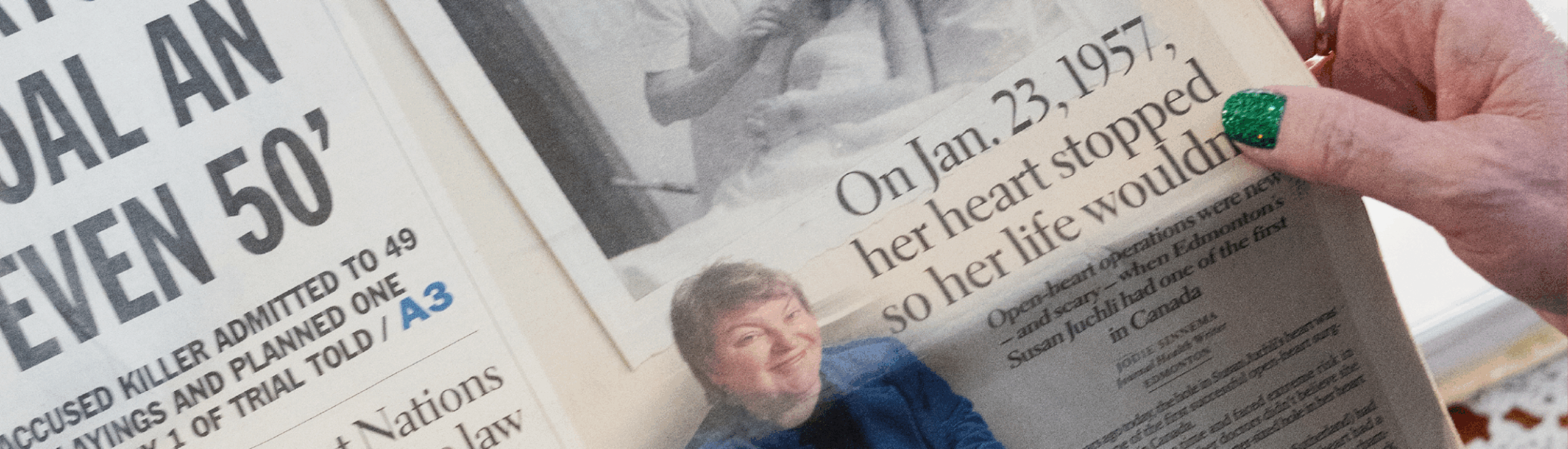

When Susan Juchli was nine years old, heart surgery was still rare, experimental, and frightening — especially for children. Few families had ever heard of a child surviving open-heart surgery, let alone going on to live a full, ordinary life.
Susan did.
“I had a hole in my heart,” Susan explains simply. Doctors identified an interventricular septal defect when she was six months old, but treatment options were limited in the early years of pediatric cardiac care. As she grew, the condition quietly shaped her childhood. “I was very limited,” she says. “I’d be out of breath. I couldn’t play tag or do skipping or hopscotch.”
Growing up in Edmonton, Susan learned early that her heart set boundaries other kids didn’t have. “I could ride my older brother’s bicycle,” she recalls, “but that was about it.”
In the early 1950s, surgeons at the University of Alberta Hospital were beginning to attempt heart repairs that had never before been possible. Outcomes were uncertain. Risks were high. When Susan was offered surgery, her parents were terrified. “My mom and dad were really nervous,” Susan says. When doctors asked whether Susan could be among the very first children to undergo the procedure, her parents asked to wait. “They just wanted to be sure.”
When Susan finally went into surgery, she wasn’t afraid. “I wasn’t nervous,” she says. “I knew it was going to really help me.”
Recovery wasn’t immediate. An infection slowed her healing. But when she turned the corner, everything changed. “After that, I felt a hundred percent better,” Susan says. “That’s when I started learning new things.”
For the first time, she could do what other kids took for granted. “I could finally play tag,” she says, smiling. “The whole neighbourhood would play tag. It was amazing.”
That early, courageous surgery didn’t just change Susan’s life — it helped open the door to the cardiac care Albertans rely on today. Susan went on to finish school, travel the world, live and work in Nigeria, marry her husband Doug in 1971, and raise two children.
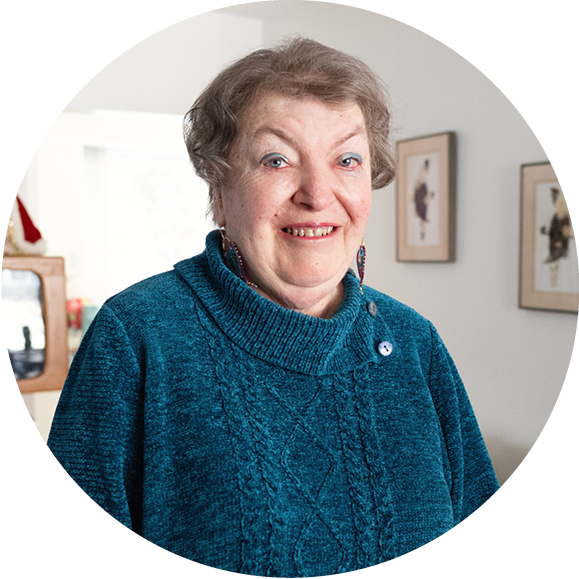
Today, approaching her 78th birthday, Susan’s heart is still strong. “We saw the heart surgeon a couple of weeks ago,” Doug says. “She said her heart is doing good.”
Susan’s story is a reminder that the advanced heart care we count on today began with bold steps, brave families, and patients like her — children whose surgeries helped make the future possible.